Animal Facts
Bufallo
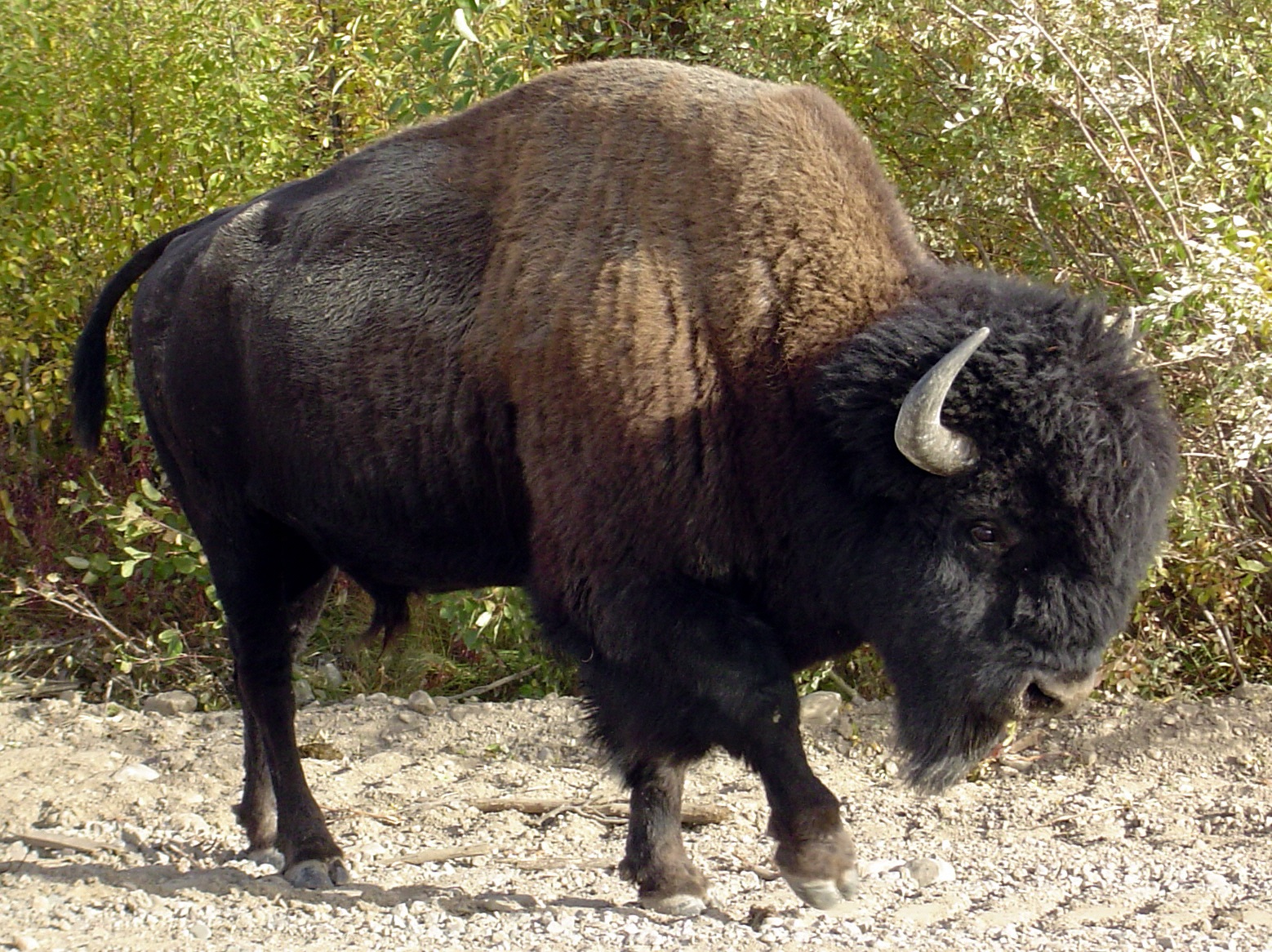
The American wild ox is one of the symbols of the United States of America and, alongside the bald eagle, can be discovered delineated on different coins and banners all through the countries history.
As of late it is considered by some to be more precise to allude to the New World wild ox as a buffalo, since it isn't in an indistinguishable class from the two bison of the Old World.
The contention is questionable notwithstanding, in light of the fact that the old world wild ox don't share a class either, and there is a fourth creature called the gaur or "Indian buffalo", which has a place in yet another different variety, with various ancestry.
The truth of the matter is, there is little perplexity in distinguishing the creature, especially when the expression "American wild ox" is utilized, and similarly as we normally say "pooch" and "feline" rather than "Canine" and "cat", the basic term ought not be viewed as off base.
The creature has been alluded to as a "bison" - which is a type of a French word "boeuff", basically signifying "substantial cow", and from which "meat" additionally comes - all through its history, and "wild ox" has been utilized as a part of reference to the American creature as far back as 1635.
The American wild ox isn't observed to be alluded to as a buffalo until 1774. At the point when individuals discuss the American buffalo and the American wild ox they allude to a similar creature.
There is an European buffalo too, that, albeit isolated by seas, looks particularly like the American buffalo or bison, and is essentially thought to be a similar creature.
The Old World "bison" are the Cape wild ox of Africa, and the tamed water wild ox of Asia. The most clear distinction is that they do not have the thick, wooly hide of the American wild ox, and are normally dark in shading.
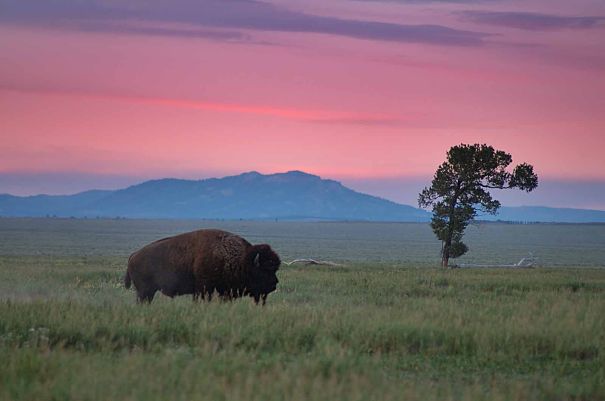
wild ox species
The horn shape is diverse also, with the Old World wild oxen having longer horns that bend back in towards each other.
At long last, these creatures are bovines from the subfamily bovinae, which are all essentially dairy animals like creatures with cloven hooves and multi-chambered stomachs.
The American wild ox once numbered more than 65 million in number crosswise over nearly the whole mainland of North America. Before the finish of the 1800's their numbers were decreased to a couple of hundred.
Presently, with sorted out preservation endeavors, the quantity of wild buffalo wandering the open range is around 16,000, and there are near 500,000 people living in huge, exclusive crowds.
Local Americans And The American Buffalo
The American buffalo or American bison once wandered the mainland of North America in such mass, that a jogging group would leave a dark swathe of trodden soil afterward.
Local individuals, especially the Dakota, Lakota and Nakota Sioux, were obliged to the wild ox for their extremely way of life. These clans took after the wild ox and arranged every year around the moving crowds.
They chased bison in a few entrancing ways.
Before they had steeds, they would wrap themselves in wolf covers up and slither sufficiently close to utilize a bow and bolt. This method worked just with crowds of "lone ranger" guys who did not fear wolves. The Indians discovered they could approach inside yards of the crowd when wearing wolf skins which concealed their aroma, where the bison would escape in the event that they got the fragrance of the Indians drawing closer. Groups with females and youths were careful about wolves and couldn't be chased with this system.
Indians in the Dakotas utilized an exceptionally emotional chasing style, which included rushing a wild ox group over a precipice. This was known as a "wild ox hop" and there is a specific site in South Dakota where a great many bison bones and several Indian sharpened stones can be found at the foot of a precarious precipice.
The local Americans had incredible regard for the wild ox, and some had faith in a god with the leader of a bison called Tatanka. The word was likewise utilized as the word for wild ox in numerous Sioux local American social orders.
In the mid 1800's the United States Government endeavored to wipe out the wild ox, not on the grounds that they needed to be freed of bison, but since they needed to wipe out the Indians.
In light of the fields Indians reliance on the wild ox for their survival, the creatures were chased around the U.S. Mounted force in numbers so awesome that the armed force couldn't utilize all the meat and covers up.
They truly consumed a great many bodies subsequent to butchering them, with the goal that they couldn't be used.
In the Indian culture, relatively all aspects of the valuable creature was reaped and put to utilize. Covers up for garments and lean-tos, bones for apparatuses, every palatable part utilized for various formulas and tonics. The tongues, eyes, horns and hooves all put to utilize.
For the Native American, seeing their valuable wild ox butchered and consumed, more likely than not been basically shocking..
Kinder hearts won in the most recent long periods of that century, and the conservation of the species can actually be followed to a few little gatherings of people moved to zones of the nation where they would be secured.
Wild ox Reproduction
Wild ox way of life is really like the way of life of the African elephant. The crowd is driven by a shrewd female authority who picks brushing zones and snoozing locales and timetables all through the majority of the year.
Inside the group are females and their adolescents, the females having a very much characterized chain of importance which is useful for participation and keeping the peace.
Guys live in littler gatherings called "single man crowds" and sporadically will move about in lone until the point when the mating season. In July, females start to become game and the guys will begin their endeavors to pull in ready females.
Predominant guys will howl, charge and head-however different guys to ward off them from their females. These fights are not by and large genuine and the less forceful or littler male will essentially locate another female to tend or hold up till later in the season.
Mating season will last until September, and after that the guys will subside once more into their own groups. Guys have nothing to do with the raising of calves.
The calves are conceived a significantly lighter shading than the grown-ups. They have thick fleece, and little tabs on their heads called "catches" where their horns will before long begin to develop. The females bring their calves up in their maternal group where the edgy adolescents skip together in little "kindergartens" that are viewed over by every one of the moms.
At the point when calves are youthful, they may fall prey to bears or mountain lions, yet wolf packs represent the most serious risk.
Wolf packs are especially talented at chasing wild ox, and utilize their great "tag-group" chasing way to deal with run the crowd until the weakest fall behind.
The endowment of speed and the capacity to run is basic to the survival of the youthful wild ox, and infants are up and running with the crowd inside 20 minutes of birth.
For what reason Aren't There Domestic Buffalo?
The bison is essentially an expansive cow - a ruminant which has a four-section stomach for separating nourishment that would be undigestable by numerous different animals.
It spends extend periods of time biting and re-biting the grass of the fields. With their short necks they just can twist their head down and eat easily to a stature of around six inches, and by leaving that measure of grass, the plant survives and recovers.
Wild ox more often than not drink by strolling into the stream or waterway till they can serenely achieve the water.
Their unfathomably extravagant hide swamps off in the mid year in sheets, in a procedure, called "shedding", which leaves hills of disposed of hair all through the valley.
Endeavors to train the bison have bombed wretchedly, and regularly brought about wounds, in light of the fact that alongside its monstrous size, the bison has a wild heart and has been depicted by the individuals who attempted, similar to a creature that can't be restrained.
Indeed, even wild ox dairy animals brought up in bondage decline to be drained.
A Few More Buffalo Facts
- The American buffalo and the American wild ox are a similar creature
- The name "buffalo" is all the more usually acknowledged and is the name of the creatures zoological class and zoological species
- There were at one time an expected 65 million wild ox wandering indiscriminately in North America
- The bison is the biggest land creature in the New World
- November second is National Bison Day!
- in the 1800's the wild ox was relatively chased to annihilation by the U.S. Government trying to starve out the Native Americans
- Both male and female wild ox have horns
- The European buffalo lives in Poland and looks precisely like the American buffalo - Buffalo Facts!
